The Bayesian Logistic Regression Model for Phase 1, dose escalation trials

January 21, 2026
Author: Miguel Pereira
The Bayesian Logistic Regression Model (BLRM) is our ‘go-to’ methodology at Cogitars to conduct phase 1, dose escalation trials.
In this article, we explore the BLRM and the Escalation with Overdose Control (EWOC) criterion and why it is our method of choice for dose finding trials.
What is the Bayesian Logistic Regression Model (BLRM)?
Let’s start from the end and explore what each word means:
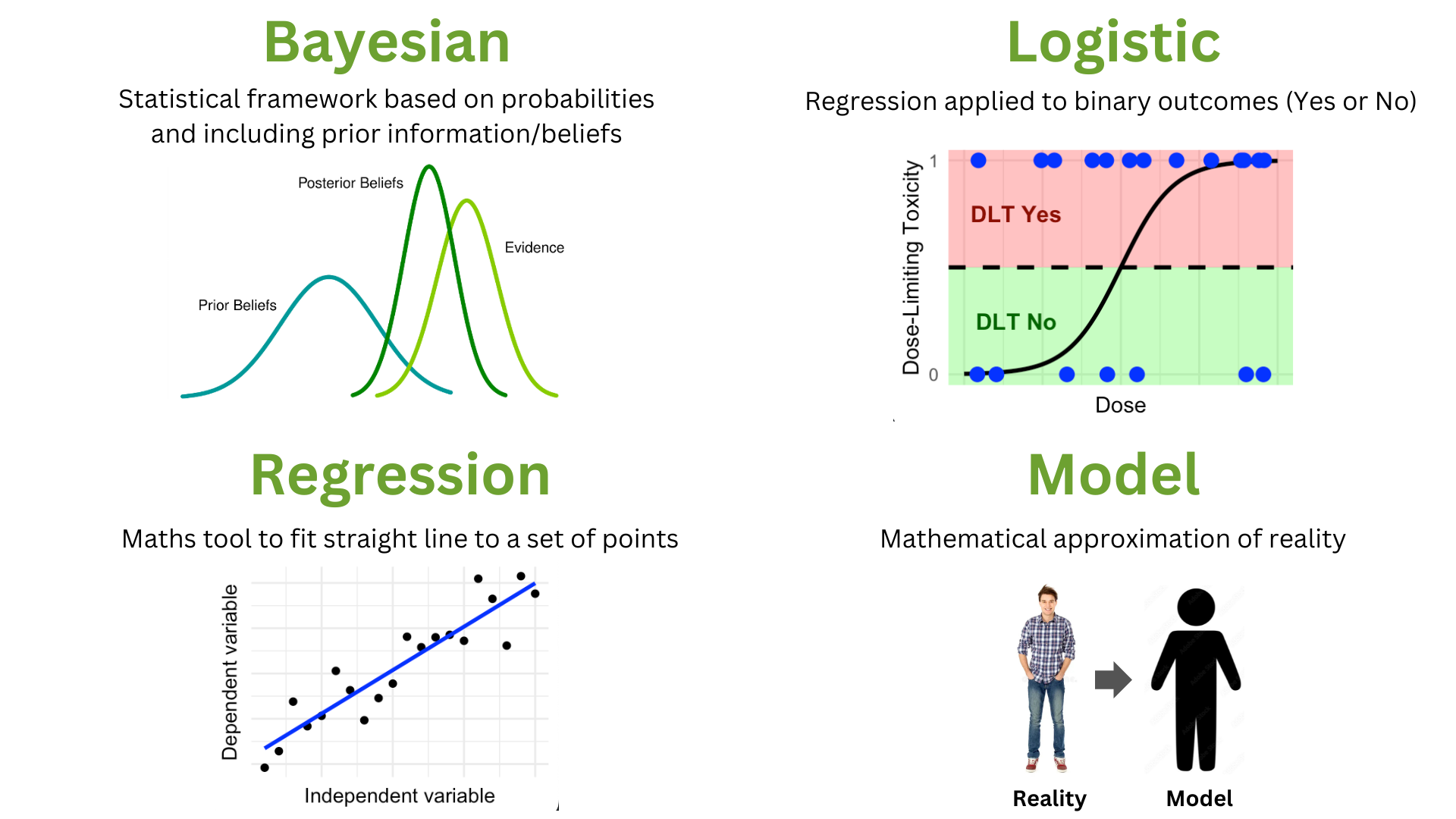
- Model - this means we are using a mathematical approximation of reality
- Regression - mathematical tool that fits a straight line to a set of points. The most commonly known is linear regression
- Logistic - Regression applied to binary outcomes (Yes or No). In this case, whether a patient has a dose-limiting toxicity (DLT) or not
- Bayesian - Statistical framework that combines prior information with the observed data to get a result.
Putting everything together, what were are doing is estimating the slope of a straight line that associates the dose to the probability of seeing a DLT. The bigger the slope the more toxic the drug is.
What is the EWOC criterion and how does it work with the BLRM?
The normal BLRM aims to find a dose that has a corresponding probability of DLT that falls within a certain interval (e.g. 20-33%).
Instead of using this, we apply the EWOC principle whereby we calculate the probability that the DLT rate exceeds a certain value (e.g. 33%).
In short, we want to know:
Probability (DTL rate > 33%) > 25% ← (this is actually the usual criterion we use)
We make a decision to stop if the probability exceeds our threshold (e.g. 25%). This decision to stop can be either at the current dose, because it is too toxic, or we can stop because the next dose level is predicted to be too toxic. This is a key aspect of model-based approaches like the BLRM where we can predict the toxicity of doses that have not yet been tested in the trial.
But why does it have to be Bayesian?
- Due to small sample sizes - usually 3-6 patients per dose level in phase 1 trials. Non-Bayesian logistic regression, without using prior information, would not provide enough precision
- It’s the Bayesian framework that gives us the ability to calculate the probabilities that we need to apply the EWOC principle
And why does Cogitars use this approach?
- It has better accuracy and a higher success rate in identifying the MTD. Much superior to the 3+3 design, with 2x the trials correctly identifying the maximum tolerable dose
- Very flexible
- Allows different cohort sizes → different doses can have a different number of patients
- Can accommodate intermediate doses
- Can accommodate doses not initially specified in the protocol which can be calculated by predicting a higher dose that is still considered safe by the BLRM
- Adaptive
- 2 DLTs in 6 patients do not always require de-escalation - depends on all data in the trial
- Aside from the EWOC criterion, there are no other hard rules
- Predictive
- At each dose, the model not only declares if the dose is safe. It also predicts if the next dose(s) are safe
- Considers all the data collected before when analysing the current dose and making decisions
- Can integrate prior information on the drug (e.g. from pre-clinical studies)
Conclusion
One can argue that this is more complex than the 3+3 design and the other rule-based designs. I won’t disagree but with the added complexity, we have flexibility in the number of patients enrolled per cohort and in the doses levels tested. Additionally, we can predict if the next dose level is safe based on what was already observed in the trial.
From our experience working with small and medium-size pharmaceutical and biotech companies, the decision between flexibility and complexity goes in favour of flexibility since that is key for speed, efficiency and cost-saving.